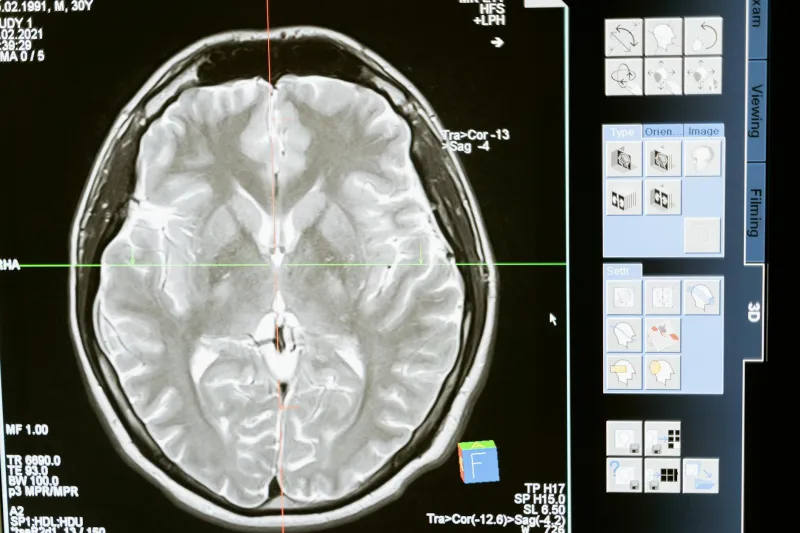
Scroll through LinkedIn on any given day and you'll find professionals proudly declaring themselves "right-brain creatives" or "left-brain analytical types." Corporate team-building exercises still sort employees into these categories. Online quizzes promise to reveal which side of your brain dominates your personality. There's just one problem: neuroscience research has conclusively shown that the left-brain/right-brain personality theory is complete nonsense.
How a Medical Discovery Became Pop Psychology
The left-brain/right-brain myth emerged from legitimate scientific research in the 1960s. Neurosurgeon Roger Sperry studied patients who had undergone corpus callosotomy — a procedure that severs the connection between brain hemispheres to treat severe epilepsy. These "split-brain" patients provided unique insights into how the hemispheres normally communicate.
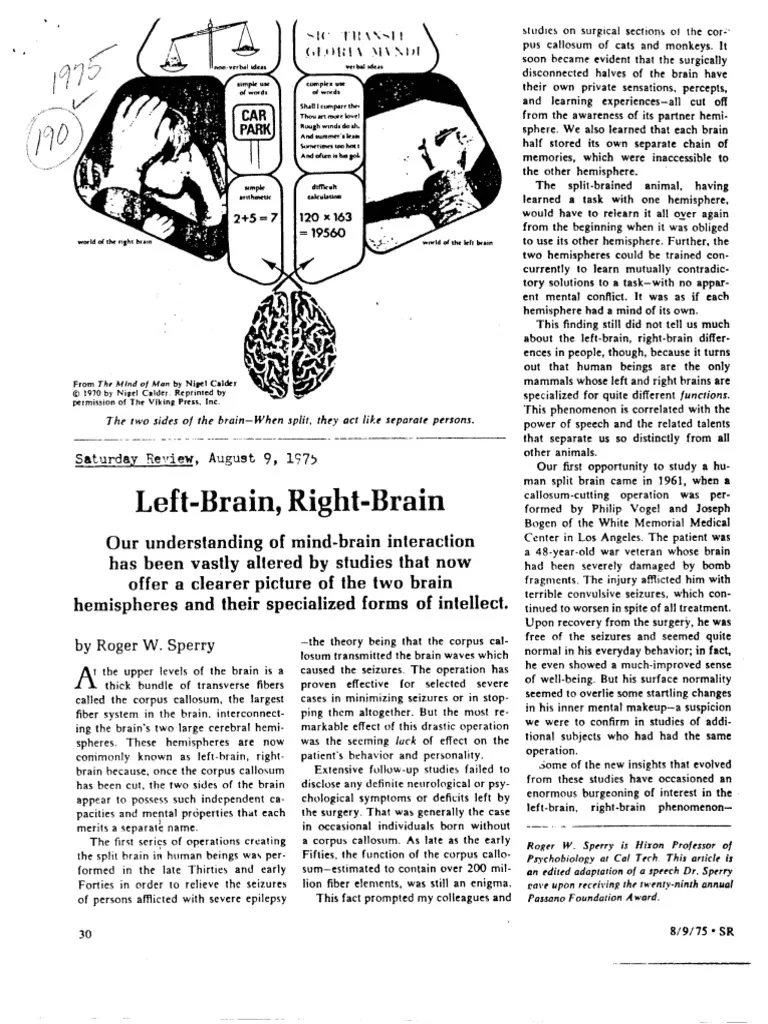 Photo: Roger Sperry, via imgv2-1-f.scribdassets.com
Sperry's research revealed that the left hemisphere typically handles language processing, while the right hemisphere showed strengths in spatial reasoning and visual processing. In split-brain patients, these differences became dramatically apparent because information couldn't transfer between hemispheres.
The findings were groundbreaking and earned Sperry a Nobel Prize. But somewhere between the laboratory and popular culture, the nuanced discoveries about split-brain patients morphed into sweeping claims about normal brain function.
The Oversimplification That Launched a Thousand Workshops
By the 1970s and 1980s, self-help authors and corporate trainers had transformed Sperry's research into a simple personality framework. The left brain became associated with logic, analysis, mathematics, and sequential thinking. The right brain supposedly governed creativity, intuition, artistic ability, and holistic thinking.
This binary framework proved irresistible for several reasons. It offered a simple explanation for complex human differences. It validated people's sense of their own strengths and limitations. Most importantly for the business world, it provided a seemingly scientific basis for categorizing employees and organizing teams.
Education consultants began promoting "right-brain teaching methods" for creative subjects. Management training programs sorted executives into left-brain and right-brain leadership styles. The concept spread through corporate America like wildfire, creating an entire industry around brain-based personality typing.
What Brain Imaging Actually Reveals
Modern neuroimaging technology has allowed scientists to observe healthy brains in action, and the results demolish the hemisphere personality theory. When people perform tasks associated with "left-brain" thinking like mathematical calculations, both hemispheres show activity. Similarly, "right-brain" activities like drawing or musical improvisation engage networks across both sides of the brain.
A landmark 2013 study at the University of Utah analyzed brain scans from over 1,000 people aged 7 to 29. Researchers measured activity in 7,000 brain regions while participants rested, looking for evidence that individuals might favor one hemisphere over the other. They found no such pattern.
While certain functions do show some hemispheric specialization — language processing tends to be left-lateralized in most people — this doesn't translate to personality differences. A person with strong language skills doesn't have a "more left-brained" personality than someone who struggles with verbal tasks.
The Persistence of Professional Pseudoscience
Despite overwhelming scientific evidence against hemisphere personality theories, they remain entrenched in corporate training and professional development. Several factors explain this persistence:
Investment in existing programs: Companies have spent millions developing training curricula around left-brain/right-brain concepts. Admitting these programs are based on false premises would require costly overhauls and potentially embarrassing acknowledgments of wasted resources.
Consultant expertise: Thousands of trainers and consultants have built careers around hemisphere-based personality assessments. Abandoning these frameworks would require learning new approaches and potentially losing competitive advantages in familiar markets.
Client satisfaction: Participants often enjoy left-brain/right-brain workshops because they provide clear, memorable categories for understanding themselves and colleagues. The fact that these categories lack scientific validity doesn't diminish their psychological appeal.
Lack of scientific literacy: Many HR professionals and corporate trainers lack the neuroscience background needed to evaluate the research critically. They rely on training materials and certification programs that may not reflect current scientific understanding.
The Real Neuroscience of Individual Differences
While hemisphere dominance doesn't explain personality differences, genuine neurological variations do exist between individuals. Brain imaging studies have identified differences in:
Network connectivity: Some people show stronger connections between brain regions associated with attention and focus, while others have more robust networks linking areas involved in creativity and divergent thinking.
Neurotransmitter systems: Individual differences in dopamine, serotonin, and other chemical messengers influence personality traits like risk-taking, social behavior, and emotional regulation.
Brain structure: Variations in the size and organization of specific brain regions correlate with different cognitive strengths and behavioral tendencies.
These real neurological differences are far more complex than simple left-right categorizations, involving intricate networks that span both hemispheres and interact in sophisticated ways.
Why Simple Categories Feel So Right
The left-brain/right-brain framework persists partly because it satisfies fundamental human needs for categorization and self-understanding. People want to know why they excel at certain tasks while struggling with others. They seek frameworks that help them understand their colleagues and optimize team dynamics.
The binary nature of the left-brain/right-brain model makes it particularly appealing. Unlike more accurate but complex models of personality and cognitive differences, hemisphere theory offers clear, memorable categories that feel scientific without requiring deep expertise to understand or apply.
Moving Beyond Hemisphere Myths
Recognizing that the left-brain/right-brain personality theory lacks scientific support doesn't mean abandoning efforts to understand individual differences. More accurate frameworks exist:
Cognitive style assessments measure genuine differences in how people process information, solve problems, and make decisions without relying on debunked brain theories.
Personality models like the Big Five provide scientifically validated ways to understand individual differences in behavior and preferences.
Strengths-based approaches focus on identifying and developing individual talents without making unfounded claims about brain function.
The next time someone asks whether you're left-brained or right-brained, you can confidently answer: neither. Your brain works as an integrated whole, with both hemispheres contributing to everything you think, feel, and do. That's not just more accurate — it's far more impressive than any simple binary could ever be.