Ocean Exploration Claims Are Missing the Point — We've Actually Mapped More Than You Think
The 5% Statistic Everyone Quotes
Walk into any conversation about ocean mysteries, and someone will inevitably mention that humanity has only explored 5% of the ocean. It's become the go-to fact for emphasizing how little we know about our own planet, repeated in documentaries, classrooms, and social media posts with the confidence of established science.
The problem? That number is both technically accurate and completely misleading, depending on what you think "exploration" means.
What Counts as Ocean Exploration?
The confusion starts with how scientists define exploration versus mapping. When marine researchers say we've only "explored" a small fraction of the ocean, they're talking about direct human observation — submersibles with cameras, divers with equipment, or robotic vehicles collecting samples.
By that definition, the 5% figure actually might be generous. The deep ocean is vast, dark, and under crushing pressure. Sending humans or even robots to every location would be like trying to explore every square foot of North America on foot.
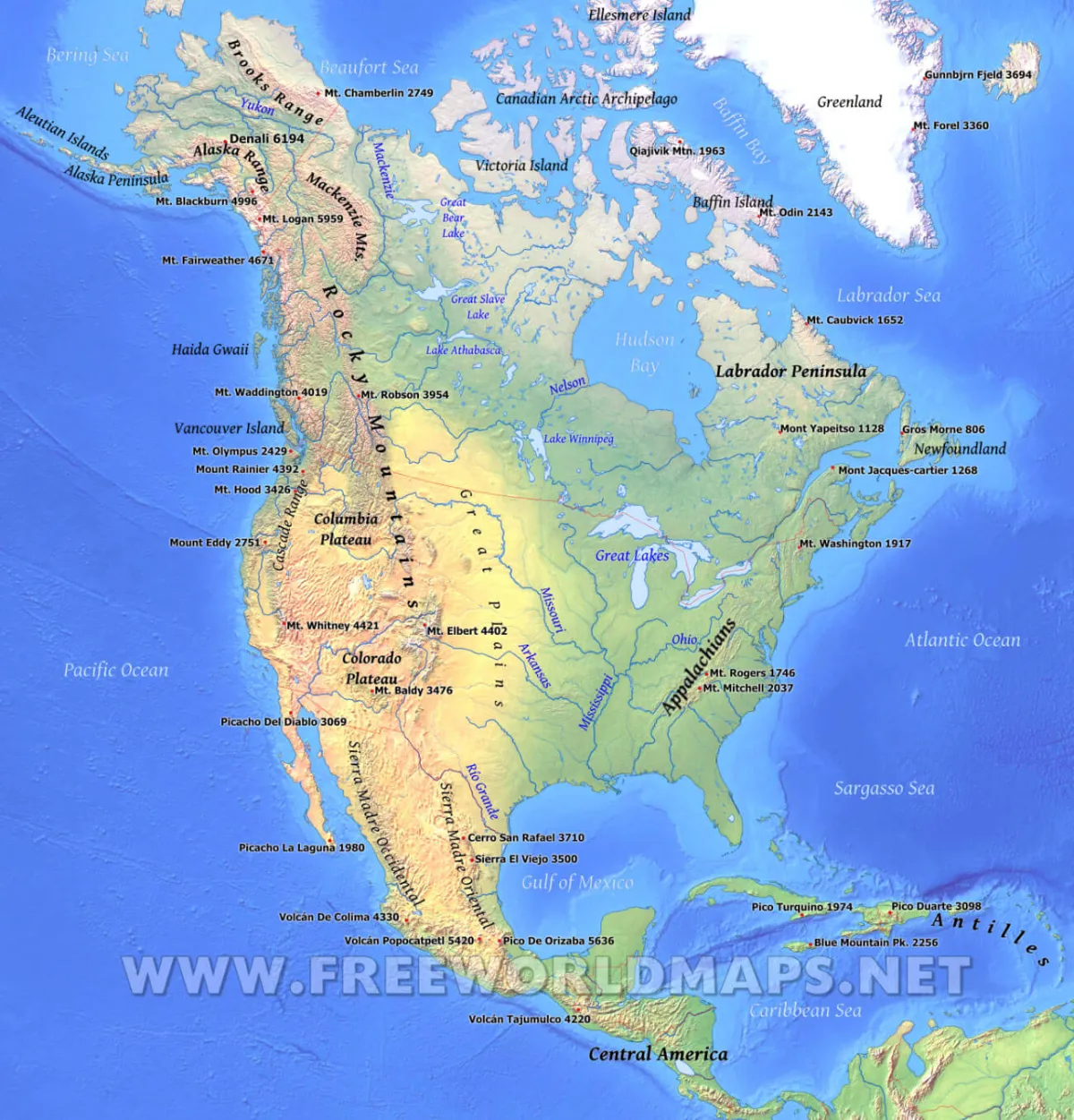 Photo: North America, via www.freeworldmaps.net
But here's what that statistic doesn't capture: we've actually mapped nearly the entire ocean floor using satellite altimetry and sonar technology.
The Technology That Changed Everything
Satellite altimetry measures tiny variations in the ocean's surface height — variations caused by the gravitational pull of underwater mountains, trenches, and other seafloor features. This technology can detect seamounts as small as a few miles across and has revealed the basic topography of virtually every part of the ocean floor.
Ship-based sonar mapping provides even more detail for areas where research vessels have traveled. Modern multibeam sonar can create incredibly detailed bathymetric maps, showing underwater canyons, ridges, and volcanic formations with precision that would have been impossible just decades ago.
The result? Scientists have a remarkably complete picture of what the ocean floor looks like, even in areas no human has ever visited.
Why the 'Mystery Ocean' Narrative Persists
The "we know more about Mars than our own ocean" comparison has become a cliché precisely because it captures something emotionally compelling. Mars feels knowable — we can see its surface, send rovers to drive around, and take detailed photographs. The ocean feels alien because it's dark, deep, and largely invisible from our surface-dwelling perspective.
This narrative also serves practical purposes. Ocean research is expensive, and emphasizing the unknown helps scientists secure funding for expeditions and new technology. When the National Ocean Service says we've explored less than 20% of the ocean, they're making a case for continued investment in marine science.
Media coverage amplifies this framing because mystery sells. "Scientists Map Entire Ocean Floor" doesn't generate clicks the way "95% of Ocean Remains Unexplored" does.
What We Actually Know
The reality is that modern ocean science operates on multiple levels of knowledge. We know the basic geography of the entire ocean floor. We understand the major current systems, temperature patterns, and chemical composition of seawater. We've identified the locations of most major underwater geological features.
What we don't know is the detailed biology, chemistry, and geology of specific locations. We haven't catalogued every species living in deep ocean trenches. We haven't analyzed water samples from every corner of the Pacific. We haven't sent cameras to document every underwater ecosystem.
It's the difference between having a map of the United States and having detailed knowledge of every forest, every stream, and every animal living in every national park.
The Real Exploration Challenge
The actual frontier in ocean science isn't discovering new continents or mountain ranges — it's understanding the complex biological and chemical processes happening in environments we can already locate and map.
Deep-sea mining companies know exactly where to find valuable minerals on the ocean floor, not because they've sent submarines everywhere, but because satellite and sonar mapping has revealed the geological formations where these deposits typically occur.
Marine biologists studying climate change can predict where ocean currents will carry heat and carbon dioxide because decades of research have mapped these systems in detail, even if they haven't physically visited every location.
Why This Distinction Matters
Understanding what we actually know about the ocean changes how we think about marine conservation, resource extraction, and climate science. We're not operating blindly in a completely unknown environment — we're working with detailed maps and extensive data, even if we haven't sent cameras everywhere.
This knowledge also highlights what ocean exploration really means in the 21st century. It's less about discovering new continents and more about understanding complex ecosystems, tracking climate change impacts, and studying biological processes that could inform everything from medicine to sustainable fishing.
The Bottom Line
The next time someone mentions that we've only explored 5% of the ocean, they're technically correct — if exploration means direct human observation. But that statistic obscures the remarkable technological achievement of mapping an entire planet's underwater geography and understanding the fundamental systems that govern how our oceans work.
The ocean isn't an impenetrable mystery. It's a complex environment that we're studying with increasingly sophisticated tools, building detailed knowledge even in places no human will ever visit.