Why American Eggs Need the Fridge and European Eggs Don't — It All Comes Down to One Industrial Step
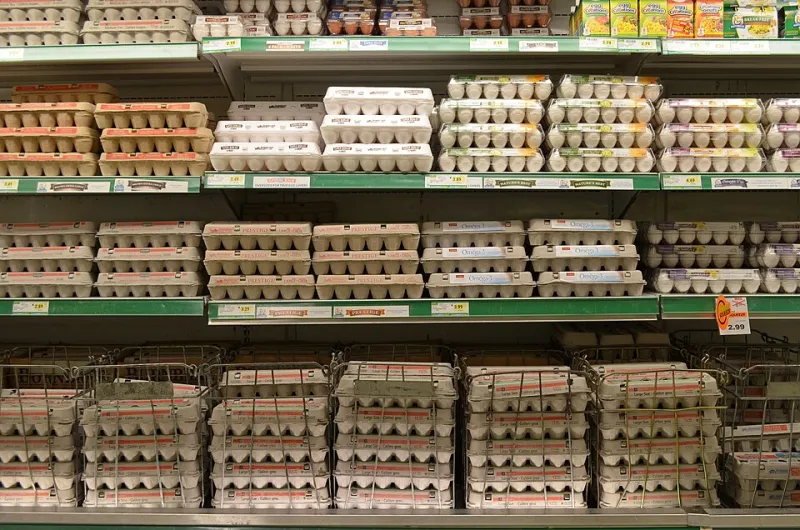
Photo: Raysonho @ Open Grid Scheduler / Grid Engine, CC0, via Wikimedia Commons
Why American Eggs Need the Fridge and European Eggs Don't — It All Comes Down to One Industrial Step
Anyone who has spent time in a European grocery store has probably done a double take at the egg aisle. There they are: cartons of eggs sitting at room temperature on a regular store shelf, no refrigeration in sight, right next to the bread and the pasta. No warning labels. No urgent signage. Just eggs, ambient temperature, seemingly unbothered.
For Americans raised on the rule that eggs live in the refrigerator — always, without exception — it registers as either a charming European quirk or a genuine public health mystery. How are millions of people not getting sick?
The answer isn't that Europeans are cavalier about food safety. It's that the eggs themselves are fundamentally different products by the time they reach the shelf — and the difference comes down to a single step that happens in the first few minutes after an egg leaves the hen.
The Cuticle: Nature's Original Packaging
When a hen lays an egg, it arrives with a natural protective coating called the bloom, or cuticle. This thin layer — barely visible to the naked eye — seals the egg's porous shell, blocking bacteria from entering and slowing moisture loss. It's essentially the egg's built-in preservation system, and it works remarkably well. An unwashed egg with its cuticle intact can sit at room temperature for several weeks without meaningful safety risk.
Salmonella, the primary pathogen concern with eggs, lives on the outside of the shell. As long as the cuticle is intact and the shell surface isn't compromised, the bacteria has a significantly harder time penetrating to the interior. The egg is designed, from an evolutionary standpoint, to survive outside a nest for a period of time — because that's exactly what eggs in nature have always had to do.
What American Egg Processing Does Differently
In the United States, commercial eggs are required by the USDA to be washed before sale. The washing process uses warm water and sometimes detergent or sanitizing agents to clean the shell surface, removing dirt, debris, and any surface bacteria — including potential Salmonella contamination.
 Photo: United States, via cdn.britannica.com
This sounds straightforwardly good. And in one sense, it is: a visually clean, sanitized shell surface is a reasonable food safety measure. The problem is what the washing also removes: the cuticle.
Once that protective coating is gone, the egg's shell — which is porous by design — becomes an open door. Bacteria that land on the now-bare shell can migrate inward more easily. Moisture escapes faster. The egg's natural defense against the outside environment has been stripped away by the same process designed to make it safer.
To compensate for this, American eggs are required to be refrigerated throughout the supply chain — at the processing facility, during transport, in the store, and in your home. Cold temperatures slow bacterial growth enough to make the washed, cuticle-free egg safe for consumption within a reasonable window. Refrigeration isn't a preference in the American system. It's a structural necessity created by the washing process itself.
Why Europe Does It Differently — And Why Neither Side Is Wrong
The European Union takes the opposite approach, and the logic is internally consistent. EU regulations actually prohibit the industrial washing of eggs sold to consumers. The reasoning: washing removes the cuticle, washing creates the refrigeration dependency, and washing introduces the risk of cross-contamination if the sanitizing process isn't perfectly executed. Better, in the EU framework, to leave the natural coating intact and let it do the job it evolved to do.
 Photo: European Union, via static.vecteezy.com
Instead, European food safety policy focuses on Salmonella control at the source — through vaccination programs for laying hens. The UK in particular implemented mandatory Salmonella vaccination for commercial laying flocks in the late 1990s, and the results were dramatic. Rates of Salmonella in British eggs dropped significantly, which is part of why the unrefrigerated shelf approach carries less risk than it might otherwise.
So European eggs don't need refrigeration because they still have their cuticle. American eggs need refrigeration because the washing process removed it. Each system has its own internal logic, and each system considers the other approach genuinely problematic — because within each system's framework, the other approach actually is riskier.
A washed American egg left at room temperature is a real food safety concern. An unwashed European egg placed in the refrigerator is also a concern, oddly enough — condensation from temperature cycling can introduce moisture and bacteria to the shell surface in ways that undermine the cuticle's protective function.
How This Became the American Standard
The US washing requirement didn't emerge from a single dramatic policy decision. It developed gradually through the 20th century as industrial egg production scaled up and the focus shifted toward visible cleanliness as a consumer quality signal. Dirty-looking eggs don't sell well. Washing made eggs look better and addressed legitimate concerns about fecal contamination on shells in high-volume production environments.
The refrigeration requirement followed logically from the washing decision, and over time the whole system became normalized. American consumers came to associate refrigerated eggs with safety and room-temperature eggs with risk — which is accurate within the American processing framework, but not a universal biological truth about eggs.
The Practical Takeaway
If you buy eggs from a US grocery store, refrigerate them. That's not overcautious — it's the correct response to how those eggs were processed. The cuticle is gone, and cold storage is doing the job it used to do.
If you happen to raise backyard chickens and collect unwashed eggs, those can safely sit on the counter for a few weeks — though most American food safety guidance still recommends refrigeration as the conservative default, since home environments vary.
And if you're ever in Europe and find yourself nervous about the shelf eggs: you can relax. The system isn't broken. It's just different — and it was designed that way on purpose.
 Photo: United Kingdom, via img.freepik.com