American Tipping Culture Isn't About Generosity — It's Filling a Wage Gap That Employers Created

American Tipping Culture Isn't About Generosity — It's Filling a Wage Gap That Employers Created
Leave 15 percent for decent service, 20 percent for good service, more if you're feeling generous. Most Americans absorbed this framework somewhere in their teens and have been operating on it ever since. It feels like a social contract — a way of acknowledging that someone did a good job.
But the reason tipping is so structurally dominant in the US — and nowhere else in the developed world at the same scale — isn't rooted in appreciation. It's rooted in a legal carve-out that allows restaurant owners and other hospitality businesses to pay certain employees far below the federal minimum wage, with the expectation that customer tips will cover the difference. That's not a cynical interpretation of the system. That's how the system was designed.
The Tipped Minimum Wage Nobody Talks About
Here's the number most Americans don't know: the federal tipped minimum wage is $2.13 per hour. That rate hasn't changed since 1991. The standard federal minimum wage, for comparison, is currently $7.25 per hour — itself widely criticized as inadequate — but tipped workers can legally be paid less than a third of that base rate.
The legal logic is called the "tip credit." Employers are technically required to ensure that tips bring a tipped worker's total compensation up to the standard minimum wage. If tips fall short in a given pay period, the employer is supposed to make up the difference. In practice, enforcement of that backstop is inconsistent, and many tipped workers report that shortfalls go uncorrected.
This framework exists because of a specific exemption written into the Fair Labor Standards Act, which has been amended over the decades to keep the tipped minimum wage frozen even as the base minimum wage increased. The restaurant industry — through lobbying groups like the National Restaurant Association — has consistently fought to preserve the tip credit system, arguing that eliminating it would force restaurant closures and higher menu prices.
Where This System Came From
Tipping in America predates the tip credit, but the two histories are tangled together in ways that matter.
Tipping arrived in the US from Europe in the late 19th century, imported by wealthy Americans who had observed the practice abroad. It was immediately controversial. Labor advocates at the time argued that tipping was degrading because it made workers financially dependent on the goodwill of customers rather than their employers. Anti-tipping movements emerged in the early 1900s, and several states briefly banned the practice.
Those bans didn't last. The restaurant and hotel industries recognized that tipping shifted labor costs from employers to customers, and they had strong incentives to keep it. When the Fair Labor Standards Act passed in 1938 establishing the federal minimum wage, tipped workers were initially excluded entirely. They were brought under the law's umbrella in 1966, but with the tip credit built in — meaning employers could count customer tips toward their wage obligations.
From that point forward, the financial incentive structure was locked in. Employers in the hospitality sector had a legal mechanism to externalize a significant portion of their labor costs onto the public. The cultural norm of tipping did the rest of the work.
Why the Percentage Keeps Going Up
Tipping started as a modest gesture — 10 percent was considered generous for much of the 20th century. By the 1980s and 90s, 15 percent had become the standard. Now 20 percent is the baseline expectation at most sit-down restaurants, and digital payment prompts at coffee shops, fast-casual counters, and food trucks regularly suggest 20, 25, or 30 percent as default options.
This escalation isn't accidental. As inflation has eroded the real value of tips, and as the gap between the tipped minimum wage and the cost of living has widened, the hospitality industry has had a financial interest in normalizing higher tipping percentages. The social pressure to tip generously — reinforced by the visible presence of tip jars, tablet prompts, and cultural messaging about service workers' reliance on gratuities — effectively recruits customers into closing a gap that employers are legally permitted to leave open.
Digital point-of-sale systems accelerated this dynamic significantly. When a screen shows you a suggested tip of 20, 25, or 30 percent and requires you to actively choose a lower amount or tap "custom," it's applying behavioral pressure in a way that a paper receipt never did. Studies on tip prompts have shown that default suggestions substantially increase average tip amounts — which is exactly why businesses use them.
How the Rest of the World Handles It
In most other developed countries, restaurant workers are paid a full minimum wage or above, and tipping is either uncommon, genuinely optional, or culturally considered mildly awkward. In Japan, tipping can be seen as rude. In Australia, service workers earn a living wage and tips are appreciated but not expected. In most of Western Europe, rounding up or leaving small change is customary — not a mandatory percentage of the bill.
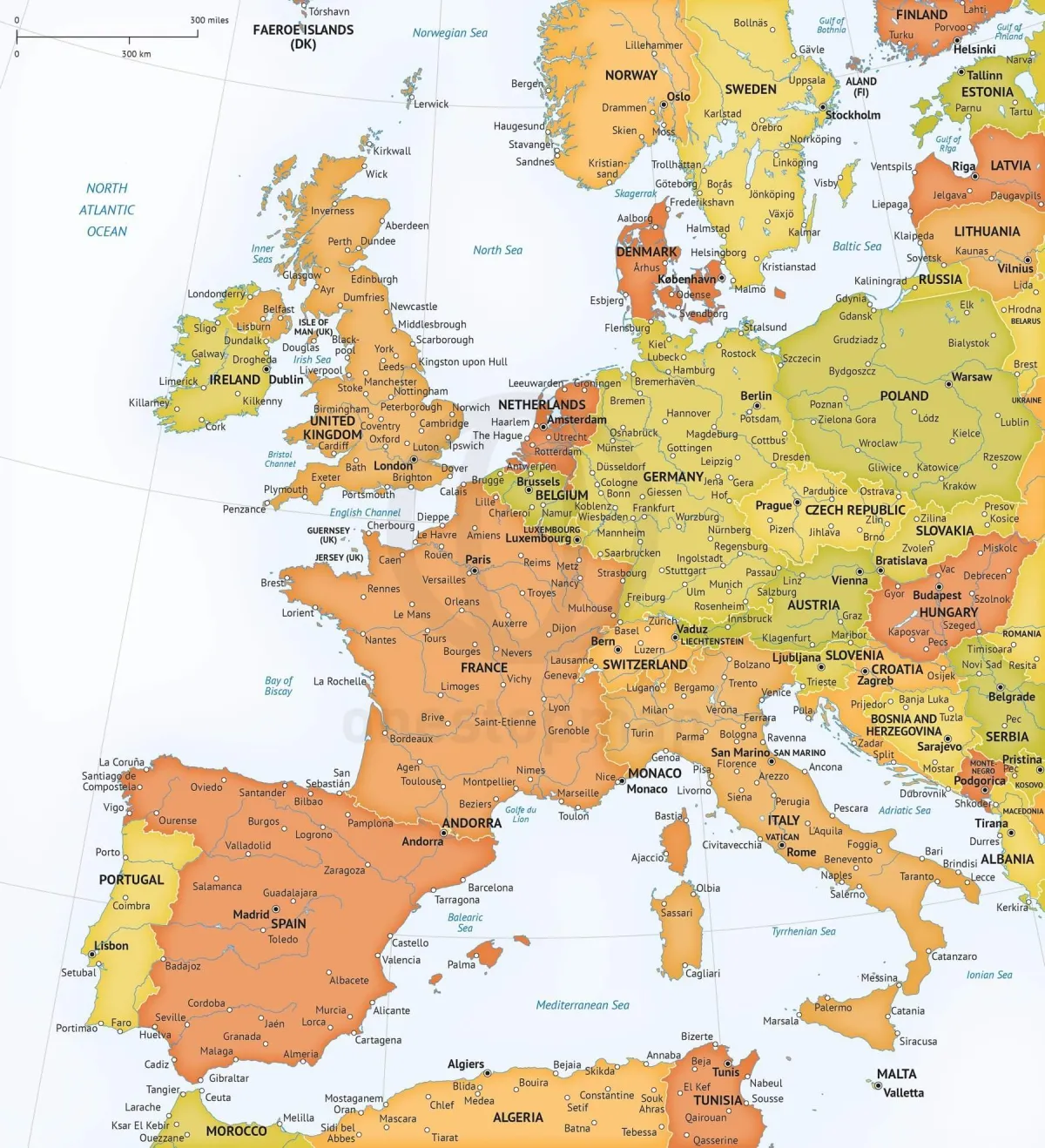 Photo: Western Europe, via www.onestopmap.com
American travelers often find this disorienting. But the difference isn't that other countries value service workers less. It's that their labor laws require employers to pay those workers without offloading the obligation to customers.
The Takeaway
None of this means you should stop tipping — in the current system, service workers genuinely depend on gratuities to make ends meet, and punishing workers for a structural problem they didn't create isn't a solution. But understanding why the system works the way it does reframes what's happening every time you tap that 20 percent button.
You're not just expressing appreciation. You're completing a wage subsidy that the law allows employers to leave incomplete. Whether that feels like a fair arrangement is a separate question — but it's worth knowing the answer before you decide.