Knuckle Cracking and Arthritis: One Doctor's Lifelong Experiment and the Folk Wisdom That Ignored His Results
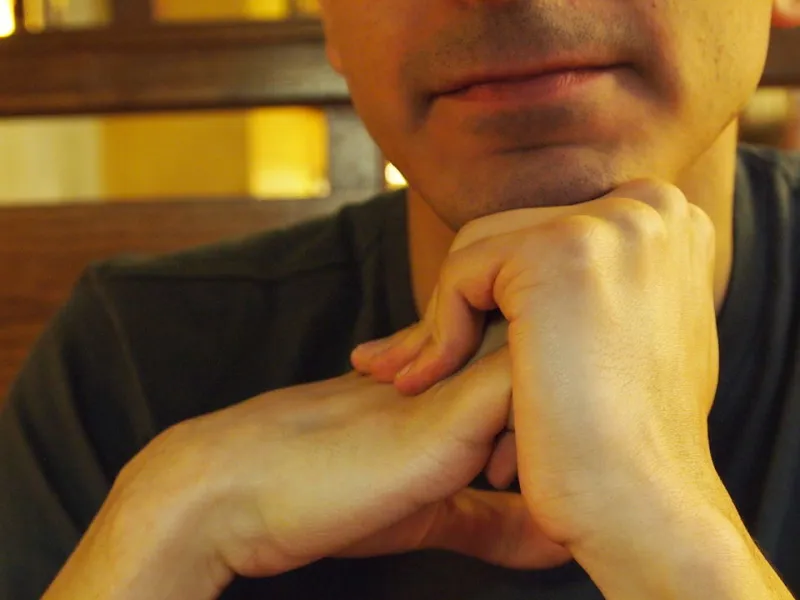
Photo: Jaysin Trevino from Evanston, IL, US, CC BY 2.0, via Wikimedia Commons
The Sound That Launched a Thousand Warnings
Few habits have generated more unsolicited parental commentary than knuckle cracking. The pop, the wince from whoever is nearby, and the immediate follow-up — you're going to get arthritis — have played out in living rooms, classrooms, and offices across America for generations. It's one of those warnings that arrives with complete confidence, passed from parent to child with the certainty of received wisdom.
The science has been quietly disagreeing for a long time. And one physician decided to settle the question with an experiment that lasted more than sixty years.
What's Actually Happening Inside the Joint
Before getting to the research, it helps to understand what knuckle cracking actually is, because the mechanism is more interesting than most people realize.
For most of the twentieth century, the accepted explanation was that the pop came from a gas bubble bursting inside the synovial fluid that lubricates your joints. The idea was that when you pull the joint apart, a gas-filled cavity forms and then collapses, releasing that distinctive sound. This was the bubble-collapse theory, and it held for decades.
More recent imaging research has complicated that picture significantly. A 2015 study using real-time MRI footage of knuckle cracking suggested that the sound is actually produced when the cavity forms — not when it collapses. The bubble appears at the moment of the crack, not afterward. The debate hasn't been fully resolved, but the updated understanding suggests the joint mechanics are more dynamic than the old model assumed.
None of this, it should be noted, involves anything being damaged. The sound is dramatic. The underlying event, in healthy joints, is not.
The 1975 Study and How It Got Elevated
The arthritis connection traces back largely to a 1975 study that examined knuckle cracking in a small group of nursing home residents. The researchers found a statistical association between habitual cracking and some degree of hand swelling and reduced grip strength. They did not find a clear link to arthritis specifically, and the study had significant methodological limitations — small sample size, self-reported cracking habits, and no way to control for other variables.
That nuance didn't survive the trip from academic journal to popular belief. What people took away was simpler: cracking your knuckles is bad for your joints. The arthritis warning was already circulating in folk wisdom before the study existed, and the study gave it a veneer of scientific credibility it arguably hadn't earned.
The Doctor Who Cracked His Knuckles for Science
Dr. Donald Unger had a different approach to the question. Bothered by his mother's repeated warnings about knuckle cracking, he decided to test the claim directly — on himself.
For approximately sixty years, Unger cracked the knuckles on his left hand twice daily while leaving his right hand completely alone as a control. At the end of the experiment, he examined both hands and found no arthritis in either. No swelling, no stiffness, no difference between the hand that had been cracked tens of thousands of times and the one that hadn't.
Unger published his findings and, in 2009, was awarded the Ig Nobel Prize in Medicine — the award given for research that first makes people laugh, then makes them think. His study was small by any clinical standard, with a sample size of exactly one. But as a direct, controlled, longitudinal test of the specific claim being made, it was hard to argue with.
What Larger Research Actually Shows
Unger wasn't alone. Multiple larger studies have examined the question and found no significant association between habitual knuckle cracking and osteoarthritis. A study published in Arthritis & Rheumatism looked at hand X-rays and cracking habits across a substantial patient population and found no meaningful difference in arthritis rates between crackers and non-crackers.
The 1975 findings about grip strength have been partially replicated in some subsequent research, which suggests that very frequent cracking over many decades might contribute to some soft tissue changes — though even that evidence is mixed. The arthritis connection, specifically, has not held up.
So Why Does the Warning Persist?
A few reasons, and they're all worth understanding.
First, the sound is viscerally unpleasant to many people. It triggers a mild disgust response, and disgust is a powerful driver of belief. If something sounds wrong, the mind is primed to believe it is wrong. The warning gives that instinct a logical home.
Second, arthritis is common and its causes are often unclear to the average person. When someone who cracked their knuckles for thirty years develops arthritis in their fifties, the habit becomes an easy explanation — even though arthritis at that age has a long list of more probable contributing factors.
Third, the warning serves a social function. It's a way to express displeasure with the habit without simply saying that sound bothers me. The health claim gives the complaint authority it wouldn't have on its own.
The Actual Takeaway
Knuckling cracking is not a path to arthritis. The research on that specific claim is about as consistent as medical research gets on a behavioral question. If you've been doing it your whole life, you're not accumulating joint damage in any way the evidence supports.
If you find it satisfying, you're in good company — and you have sixty years of one doctor's dedicated self-experimentation on your side.